The Rise of the Digital Sales Colleague: Agentic AI in B2B Marketing
Agentic marketing does not eliminate the need for humans; it clarifies it. Strategy, ethics, trust, and creative leaps remain human domains. But humans are poorly suited to continuous monitoring, pattern correlation, and disciplined follow-up.
4 min read
For most of the past decade, B2B marketing automation has been about acceleration: more leads, faster handoffs, higher volumes of content. Agentic AI marks a different shift. It is not about speed alone. It is about delegation.
An agent does not merely assist; it observes, decides, acts, and learns within defined boundaries. In B2B marketing, this matters because the sales cycle is not a funnel but a system of judgments: whom to pursue, when to engage, what to say, and when to stop. Humans remain better at strategy and trust. Machines, however, are becoming superior at pattern detection, orchestration, and relentless follow-through.
The question for CMOs and revenue leaders is therefore not whether to “use AI”, but which agents to deploy, at which stage of the sales cycle, and with what authority.
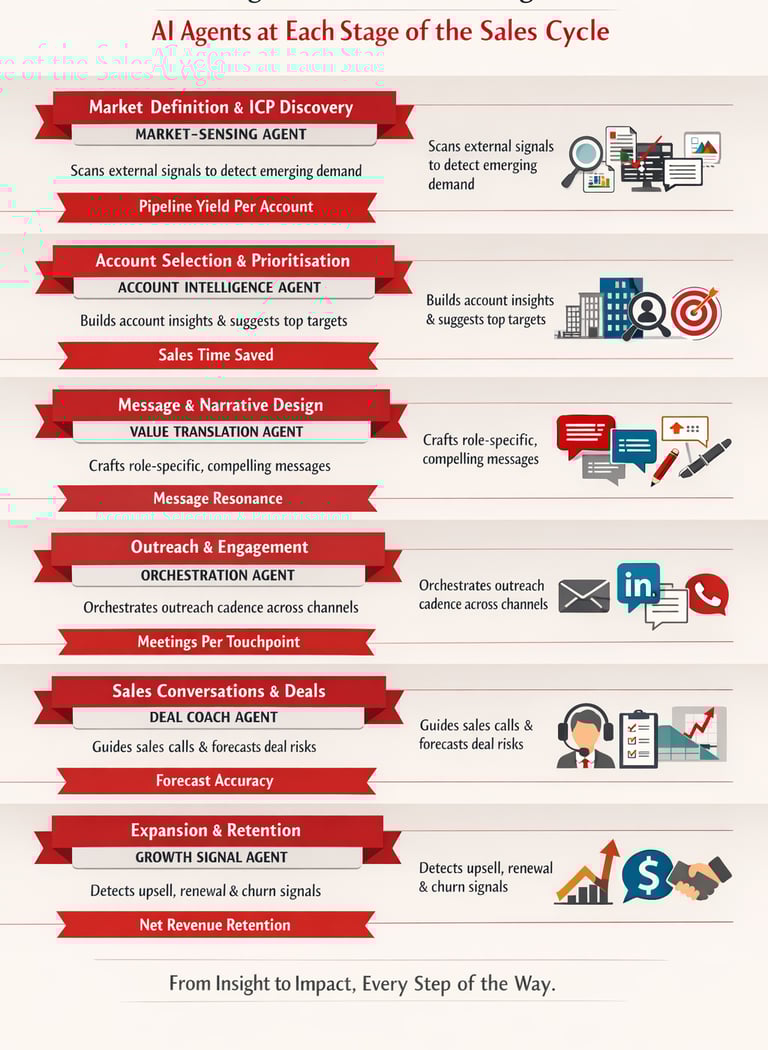
Stage 1: Market Definition and ICP Discovery
Agent required: The Market-Sensing Agent
Most B2B teams still define their Ideal Customer Profile (ICP) through workshops, anecdotes, and historical CRM data. This is like navigating with a rear-view mirror.
A market-sensing agent continuously scans the outside world. Its inputs include job postings, funding announcements, regulatory filings, earnings calls, tech-stack disclosures, website changes, hiring velocity, and competitor movements. Its task is not to generate personas, but to detect emerging demand pockets before they appear in pipeline reports.
Actionably, this agent should:
Re-score ICPs weekly, not annually
Flag “ICP drift” when real buyers diverge from marketing’s assumptions
Surface negative ICP signals (e.g. fast-growing firms that never convert)
Its output is not a slide deck but a ranked list of accounts and segments with confidence scores and rationales (Advance ABM if you will). Its success metric is not MQL volume, but pipeline yield per account targeted.
Most firms underuse this agent by restricting it to internal data. The real advantage comes from letting it roam externally (think OSINT) and then trusting its conclusions, even when they contradict last year’s strategy.
Stage 2: Account Selection and Prioritisation
Agent required: The Account Intelligence Agent
Once markets are defined, the next bottleneck is choice. Sales capacity is finite; attention is scarce.
An account intelligence agent assembles a live dossier on each target account: strategy shifts, leadership changes, budget cycles, recent wins or losses, and likely buying centres. Crucially, it does not just collect information—it interprets it.
Well-designed agents answer questions salespeople rarely have time to ask:
Why this account, now?
What internal tension might trigger a purchase?
Who is likely to resist?
Practically, this agent should:
Produce a one-page “why now” brief for every Tier-1 account
Suggest entry points by role and function
Recommend whether to pursue, nurture, or disqualify
The metric that matters here is sales time saved per opportunity and conversion from target account to first meeting. If sales still complains that “marketing doesn’t get our accounts”, this agent is either absent or ignored.
Stage 3: Message and Narrative Design
Agent required: The Value Translation Agent
Most B2B content fails not because it is poorly written, but because it is misaligned with buyer reality. Engineers receive vision statements; CFOs receive feature lists.
A value translation agent adapts the same underlying value proposition into role-specific, context-specific narratives. It maps product capabilities to business outcomes, risks avoided, and personal incentives—by buyer type.
This agent should:
Generate role-specific messaging frameworks, not just copy
Test narratives against historical win/loss data
Flag “value gaps” where claims lack evidence
Its outputs feed directly into sales decks, outbound emails, landing pages, and call scripts. Importantly, humans must still approve strategic positioning. But the first draft of relevance should belong to the agent.
The right KPI here is message resonance: reply rates, meeting acceptance, and progression speed by persona.
Stage 4: Outreach and Engagement
Agent required: The Orchestration Agent
At this stage, many teams deploy AI as a blunt instrument—automated emails at industrial scale. This is a mistake.
An orchestration agent manages sequence logic, not volume. It decides:
When to engage, what to say
Through which channel
With what intensity
And when silence is preferable to noise
It coordinates email, LinkedIn, events, content drops, and sales touches into a coherent cadence. It pauses when signals suggest resistance, and accelerates when intent spikes.
Actionably, it should:
Adjust sequences in real time based on engagement signals
Escalate to humans only when probability crosses a threshold
Kill sequences that generate activity but no progress
Its success metric is meetings per meaningful touch, not emails sent. When deployed well, sales teams notice something subtle but important: prospects are less annoyed, not more.
Stage 5: Sales Conversations and Deal Progression
Agent required: The Deal Coach Agent
Here the agent moves from marketing into sales—but remains invaluable.
A deal coach agent listens to calls, analyses emails, and tracks deal momentum. It identifies objections left unaddressed, stakeholders missing from conversations, and risks masked by superficial enthusiasm.
Its practical contributions include:
Pre-call briefs tailored to the specific deal context
Post-call summaries highlighting risks, not platitudes
Deal-level forecasts grounded in behaviour, not hope
This agent should not replace sales judgment. It should challenge it—politely, persistently, and with evidence.
The key metric is forecast accuracy and deal slippage reduction. If every deal still feels “90% done” until it dies, the agent is not empowered enough.
Stage 6: Expansion, Retention, and Advocacy
Agent required: The Growth Signal Agent
Most B2B firms obsess over acquisition and neglect the quieter signals of expansion and churn.
A growth signal agent monitors product usage, support interactions, org changes, and business performance to detect:
Upsell readiness
Renewal risk
Reference potential
It prompts marketing and sales not with generic campaigns, but with precise actions: now is the moment to propose X, or this account needs reassurance before renewal discussions begin.
Its output feeds customer marketing, account management, and product teams. Its metric is net revenue retention and time-to-expansion, not email open rates.
The Human Constraint
Agentic marketing does not eliminate the need for humans; it clarifies it. Strategy, ethics, trust, and creative leaps remain human domains. But humans are poorly suited to continuous monitoring, pattern correlation, and disciplined follow-up.
The firms that win will not be those with the most agents, but those with:
Clear decision rights for each agent
Clean data flows across the sales cycle
And the courage to let machines contradict senior opinion
Start small, but start structurally. Do not deploy agents as features; deploy them as roles with mandates, inputs, outputs, and KPIs. Begin where your revenue engine leaks most—usually ICP definition, account prioritisation, or deal progression. Give each agent authority to act, not just report. And above all, redesign workflows so humans respond to judgment, not dashboards. Agentic B2B marketing is not about replacing marketers or salespeople. It is about finally letting them focus on what only humans can do.
#AgenticAI #B2BMarketing #RevenueOperations #AISales #GoToMarket #DemandGeneration #SalesEnablement #MarketingStrategy #AIinBusiness #FutureOfSales