When Sales and Marketing Stop Talking, Revenue Stops Listening
There is a reliable early-warning indicator of stalled growth in B2B companies. It is not pipeline coverage, CAC, or even churn. It is silence—specifically, the silence between sales and marketing.
3 min read
There is a reliable early-warning indicator of stalled growth in B2B companies. It is not pipeline coverage, CAC, or even churn. It is silence—specifically, the silence between sales and marketing.
In theory, the two functions form a neat relay race. Marketing generates demand. Sales converts it. Together they expand, retain, and monetise accounts. In practice, they often behave like rival city-states, exchanging data grudgingly and blame enthusiastically. The result is predictable: leads nobody wants, deals nobody closes, and dashboards nobody trusts.
Alignment is not a slogan. It is an operating system. And like any system, it can be inspected, debugged, and improved—if leaders are willing to ask questions that make them uncomfortable.
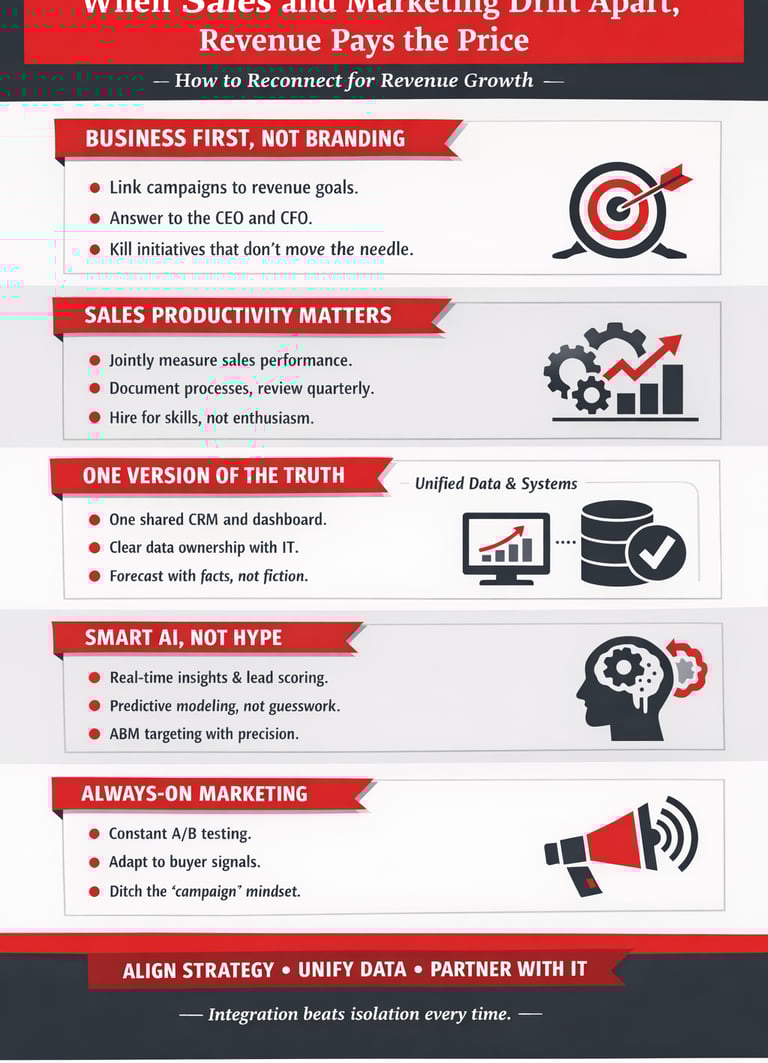
Start With the Business, Not the Campaign
The first test of alignment is brutally simple: can marketing trace its activities directly to business objectives?
If revenue targets, margin constraints, or market-entry priorities are absent from marketing plans, then marketing is not supporting growth—it is decorating it. Strategy must cascade downwards: from board-level goals to commercial objectives, into sales targets, and finally into campaigns, content, and channels.
This requires marketing leaders to work closely with the CEO and CFO, not just the CRO. If marketing does not understand how the company actually makes money—or loses it—then performance reporting becomes theatre rather than management.
A practical rule: every major marketing initiative should explicitly state which business metric it is designed to move, over what time horizon, and by how much. If it cannot, cancel it.
Treat Sales Productivity as a Shared Asset
Many organisations measure marketing activity and sales outcomes separately, then wonder why optimisation fails. Alignment begins when sales productivity becomes a joint metric.
This means answering unfashionable questions: What is the ratio of marketers to salespeople? Which marketing activities measurably reduce sales cycle time or increase win rates? Which do not?
It also means writing things down. Documented sales and marketing processes—reviewed quarterly, not annually—are the difference between scale and improvisation. Certification matters here too. Marketers who lack basic project management discipline often compensate with enthusiasm, which is rarely an adequate substitute.
Build One Version of the Truth—or Accept Fiction
Misalignment thrives in fragmented data environments. Multiple CRMs, competing dashboards, and conflicting definitions of “qualified lead” create a fog in which accountability disappears.
The solution is neither another tool nor another meeting. It is ownership. Data architecture and infrastructure must be clearly defined, governed, and maintained—typically in partnership with IT, not in defiance of it.
A single version of the truth is not a technical aspiration; it is a commercial necessity. Without it, forecasting is guesswork and AI is decorative.
Use AI Where It Replaces Guesswork, Not Judgment
Artificial intelligence does not align sales and marketing by magic. It does so by removing friction.
Used well, AI provides shared, real-time dashboards that replace anecdote with evidence. It improves lead scoring by learning from closed deals rather than marketing assumptions. It identifies emerging market signals that sales teams, focused on today’s quarter, are structurally unable to see.
In account-based marketing, AI earns its keep by identifying high-intent accounts, personalising outreach at scale, and continuously adjusting messaging based on live signals. In revenue operations, it enables scenario modelling that forces marketing tactics to confront financial reality.
Used badly, AI automates confusion faster than humans ever could.
Always-On Beats Always-Busy
The gradual disappearance of campaign-based marketing in favour of always-on models is not a trend; it is an admission of reality. Buyers do not operate on campaign calendars.
This shift demands continuous experimentation. If A/B testing is not routine—across campaigns, channels, and even brand messages—then learning is accidental rather than systematic. Always-on marketing without experimentation is merely noise, permanently switched on.
The Quiet Importance of Organisation Design
Alignment is not only about tools and metrics. It is about people.
Succession planning, skill profiles, and embedded business partners across customer service, finance, product, and IT matter more than most organisations admit. Sales and marketing do not operate in isolation; nor should they be designed that way.
Centralisation and decentralisation must also be deliberate choices. What scales should be centralised. What differentiates should not.
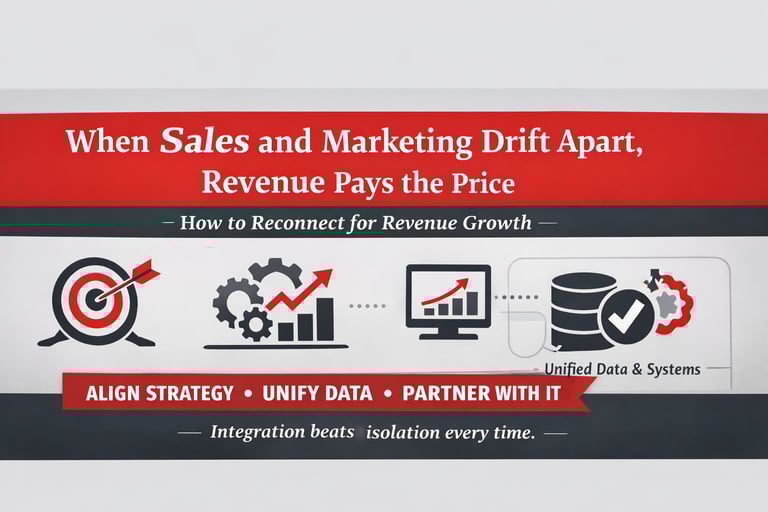
Sales and marketing leaders should stop treating alignment as a cultural aspiration and start managing it as an operating discipline. Anchor marketing strategy explicitly to business outcomes. Make sales productivity a shared metric. Enforce a single version of commercial truth. Deploy AI where it sharpens decisions, not where it flatters presentations. And above all, collaborate seriously with IT and data teams—not as service providers, but as co-owners of revenue performance. Growth rarely fails for lack of ideas; it fails for lack of integration.
#B2BMarketing #B2BSales #RevenueGrowth #SalesMarketingAlignment #ABM #AIinMarketing #AIinSales #RevenueOperations #DataDrivenGrowth #GoToMarket